HVAC and AC Are Not the Same: A Homeowner’s Guide to System Basics
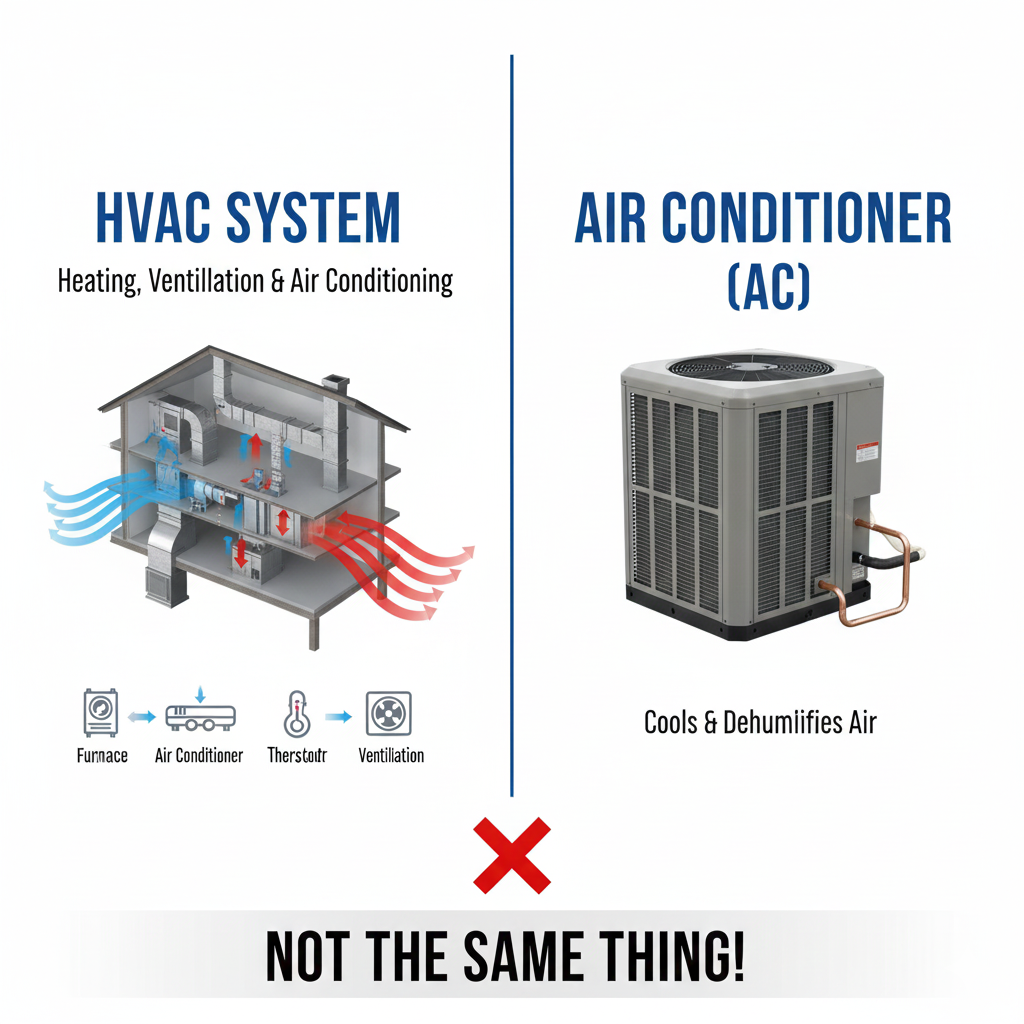
When discussing home comfort, the terms “HVAC” and “AC” are often used interchangeably. However, they refer to related but distinct concepts. For homeowners making decisions about service, upgrades, or new installations, understanding this difference between HVAC and AC systems is crucial. Using the correct terminology can lead to clearer communication with contractors and a better understanding of what your home’s systems actually do.
This guide will clarify the definitions, explain the scope of each term, and break down the components involved. You will learn that AC, or air conditioning, is a subset of a broader system. By the end, you will be able to accurately describe your home’s equipment and understand the full picture of your indoor climate control.
Defining the Core Terms: AC and HVAC
The key to understanding the difference lies in simple definitions.
What is AC?
AC stands for Air Conditioning. This term refers specifically to the process and equipment used to cool and dehumidify the indoor air of a space. When you say “the AC is on,” you mean the system is actively removing heat and moisture to lower the temperature.
What is HVAC?
HVAC stands for Heating, Ventilation, and Air Conditioning. This is an umbrella term that describes the complete system responsible for managing multiple aspects of your home’s indoor environment. An HVAC system provides heating, cooling, and air quality control.

The Simple Analogy: The Piece vs. The Whole
A helpful way to visualize the relationship is to think of AC as a key component within the larger HVAC system.
- AC is like the cooling system in your car. It’s a specific subsystem with a dedicated function (cooling the cabin).
- HVAC is like the car’s entire climate control system. It includes the heater, the AC, the fan, and the vents that manage airflow and temperature together.
In your home, the AC equipment is a part of your overall HVAC system, which also includes your furnace, heat pump, ductwork, thermostat, and air filtration components.
Breaking Down the Components of Each System
To see the practical difference, let’s look at what each term encompasses in a typical house.
Components of an AC System
When a technician refers to your “AC system” or “air conditioner,” they are typically talking about the equipment dedicated to cooling:
- Outdoor Condenser Unit: The metal cabinet containing the compressor, condenser coil, and fan.
- Indoor Evaporator Coil: Usually installed near your furnace or air handler.
- Refrigerant Lines: The copper tubing that circulates refrigerant between the indoor and outdoor units.
- The core function of these parts is solely to perform the refrigeration cycle for cooling.
Components of a Complete HVAC System
Your HVAC system includes all the equipment that works together to manage thermal comfort and air quality. It encompasses the AC components and much more:
- Heating Equipment: This could be a furnace (gas, electric, or oil), a heat pump (which provides both heating and cooling), or a boiler for radiant heat.
- Cooling Equipment: This is your AC system, as described above.
- Ventilation Components: This includes the network of supply and return ductwork, air handlers, blower motors, exhaust fans, and potentially energy recovery ventilators (ERVs) or heat recovery ventilators (HRVs) that bring in fresh air.
- Control & Filtration: The thermostat is the system’s brain. Also included are air filters, humidifiers, and dehumidifiers that regulate air quality.
The Critical Role of the “V” in HVAC: Ventilation
A major point of distinction lies in ventilation—the controlled exchange of indoor and outdoor air. A standalone “AC” system recirculates and cools the existing indoor air. A true HVAC system actively manages air quality through ventilation.
Proper ventilation does three important things:
- Removes Contaminants: It exhausts stale air containing odors, volatile organic compounds (VOCs), and excess moisture.
- Provides Oxygen: It introduces fresh outdoor air, which is essential for health and comfort.
- Controls Pressure: It helps maintain neutral air pressure within the home.
This function is why modern, integrated HVAC systems are fundamental to healthy indoor air quality, going far beyond just temperature control.
Practical Value: Identifying Your Home’s System Type
Use this simple checklist to understand what type of system you have. Look at your equipment and ask:
Do you have a system that provides BOTH heating and cooling from a single, integrated unit?
- If YES, you have a full HVAC system. Common examples include:
- A gas furnace + an AC coil (a “split system”).
- A heat pump (which handles both heating and cooling).
- A furnace with AC and a whole-house humidifier/dehumidifier.
- If NO, you may have standalone components. For example:
- A window AC unit for cooling with baseboard electric heat for warming.
- A ductless AC mini-split for cooling with a separate, non-integrated space heater.
Common Homeowner Confusion Points
- “My thermostat says ‘HVAC’ on it.” The thermostat controls the overall system. The label refers to its capability to manage multiple functions (Heat, Vent, AC), not to the equipment itself.
- “The contractor said I need a new HVAC system, but only my AC is broken.” They may be referring to the outdoor condenser unit (the AC part). It’s always wise to ask for clarification: “Are you proposing to replace just the air conditioning components, or the furnace and air handler as well?”
- “I have a heat pump. Is that AC or HVAC?” A heat pump is a full HVAC system in one unit. It provides both heating and cooling by reversing the refrigeration cycle, and it is integrated with your home’s ductwork and ventilation.
Conclusion
The difference between HVAC and AC systems is fundamental. AC (Air Conditioning) is a specific function and set of components dedicated to cooling. HVAC (Heating, Ventilation, and Air Conditioning) is the comprehensive system that provides year-round climate and air quality control by integrating heating, cooling, and ventilation.
Understanding that your air conditioner is a critical part of your larger HVAC system allows you to see your home’s comfort as an interconnected whole. This knowledge empowers you to discuss maintenance, repairs, and upgrades more effectively, ensuring you address not just temperature, but the complete health and comfort of your indoor environment.