How Air Conditioning Works: A Homeowner’s Guide

For many homeowners, the air conditioner is a vital appliance that provides comfort during warm months. You turn it on, cool air flows from the vents, and your home becomes a refuge from the heat. But have you ever wondered about the process happening behind the scenes? Understanding how air conditioning works demystifies your system, helps you communicate effectively with service technicians, and makes you more aware of its maintenance needs.
This guide explains the core principles of residential cooling in straightforward terms. We will walk through the essential components of a typical central air system, break down the refrigeration cycle step-by-step, and clarify common misconceptions. By the end, you will have a clear picture of the journey that warm indoor air takes to become the cool, conditioned air that maintains your comfort, without any complex technical jargon.
The Core Goal of Your How Air Conditioning Works
It is a common belief that air conditioners “create” cold air. In reality, they function by removing heat and humidity from your indoor air. The system transfers this unwanted thermal energy from inside your house to the outside.
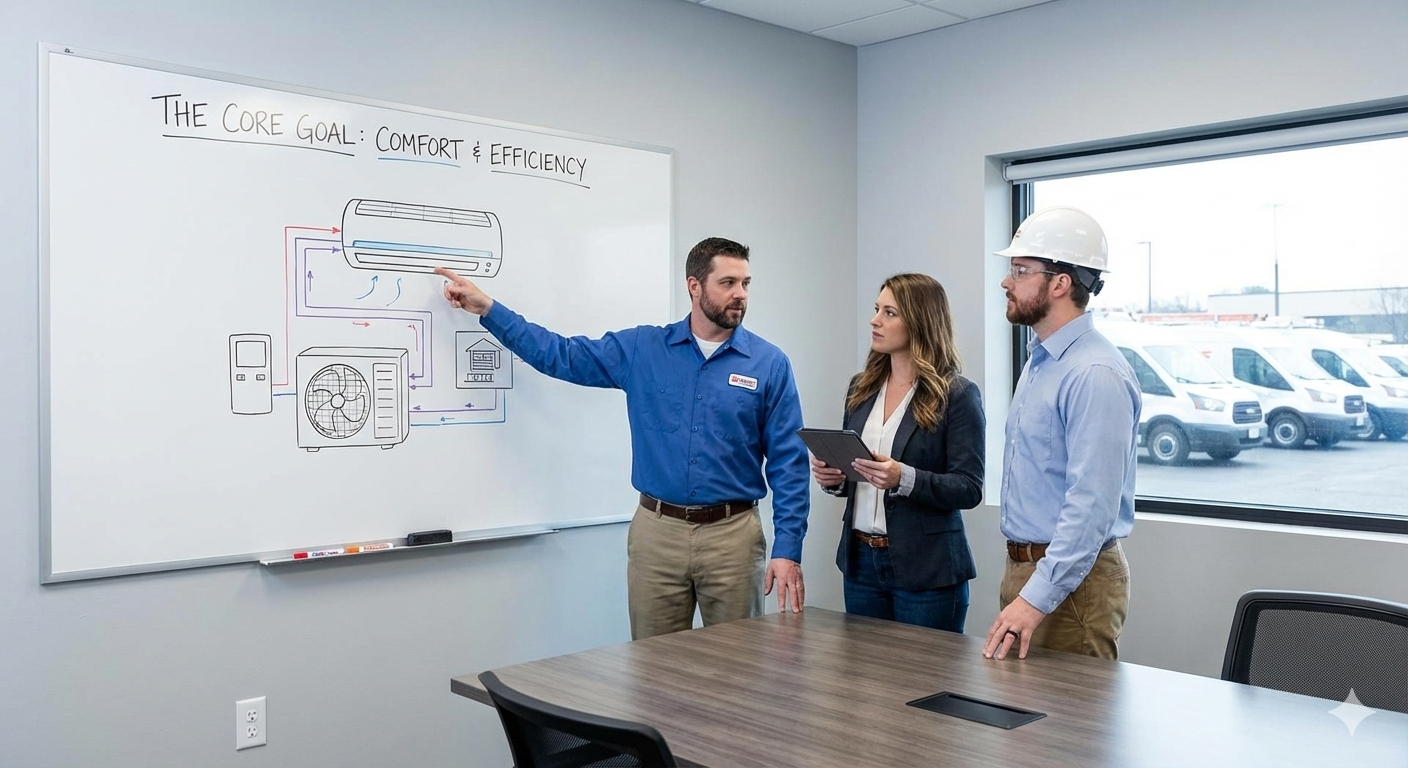
What you feel as “cool air” is simply air that has had its heat extracted. This fundamental process of heat transfer is the key to all modern residential cooling, whether you have a central system, a ductless mini-split, or a window unit.
Key Components of a Central Air Conditioning System
A central air system is split into two main sections: an outdoor unit and an indoor unit. They work in tandem using refrigerant, a special fluid that easily changes from liquid to gas and back again, to move heat. Here are the critical parts you should know.
The Outdoor Unit: The Condenser
This is the metal cabinet typically located beside your home. Its main job is to release the collected indoor heat to the outside atmosphere. Key parts inside include:
- The Compressor: Often called the heart of the system. It pumps refrigerant and pressurizes it, raising its temperature significantly.
- The Condenser Coil: A network of tubing with fins, like a radiator. Here, the hot, pressurized refrigerant gas releases its heat to the outside air and condenses back into a liquid.
- The Fan: This fan pulls outside air through the condenser coil to dissipate the heat efficiently.
The Indoor Unit: The Evaporator Coil
This component is usually installed inside your home, often in a plenum attached to your furnace or air handler.
- The Evaporator Coil: Another network of tubing. Liquid refrigerant enters this coil, expands, and evaporates into a gas. This phase change absorbs a large amount of heat from the air blowing across the coil.
- The Air Handler or Furnace Fan: This blower fan circulates warm indoor air from your home’s ducts over the cold evaporator coil. As the air loses its heat to the refrigerant, it cools down and is then pushed back through the ducts into your rooms.
Connecting the System:
Two copper tubes connect the indoor and outdoor units. They are insulated and carry the refrigerant back and forth in a continuous, sealed loop.
Refrigerant Lines
The Refrigeration Cycle: A Step-by-Step Breakdown
The movement of refrigerant through these components is a continuous four-step process known as the refrigeration cycle. This is the core mechanism of how home air conditioning operates.
1. Compression (In the Outdoor Unit): The cycle begins at the compressor. Refrigerant arrives here as a warm, low-pressure gas. The compressor squeezes (compresses) this gas, which dramatically increases both its pressure and its temperature. It now exits as a superheated, high-pressure gas, ready to release its heat.
2. Condensation (In the Outdoor Unit): This hot gas flows into the condenser coil. The outdoor fan draws ambient air across the coil. As the air cools the refrigerant below its boiling point, the refrigerant releases the indoor heat it carried and changes state—it condenses from a hot gas into a warm high-pressure liquid.
3. Expansion (At the Metering Device): The warm liquid refrigerant then moves toward the indoor unit. Before entering the evaporator coil, it passes through a small expansion valve or metering device. This device creates a pressure drop, causing the refrigerant to rapidly expand and cool. It leaves this point as a cold, low-pressure liquid-vapor mixture.
4. Evaporation (In the Indoor Unit): This chilly refrigerant enters the evaporator coil inside your air handler. As your home’s warm air is blown across the coil by the blower fan, the refrigerant absorbs the heat from that air. This causes the refrigerant to completely evaporate into a warm, low-pressure gas. The air, now cooled and dehumidified (as moisture condenses on the cold coil), is distributed throughout your home. The warm refrigerant gas then travels back to the compressor to restart the cycle
Viverra nibh cras pulvinar mattis nunc sed blandit. Aliquet eget sit amet tellus cras adipiscing enim. Rutrum quisque non tellus orci ac auctor augue mauris. Maecenas volutpat blandit aliquam etiam erat velit. Quisque non tellus orci ac auctor augue mauris augue neque. Augue lacus viverra vitae congue eu consequat ac felis. Sit amet risus nullam eget felis eget nunc lobortis.
The Crucial Role of Humidity Control
A significant secondary function of your air conditioner is reducing indoor humidity. As warm, moist air from your home passes over the cold evaporator coil, water vapor in the air condenses on the coil’s surface, much like droplets form on a cold glass of water. This water drains away through a condensate line. By removing this moisture, your system not only cools the air but also makes it feel less muggy and more comfortable.
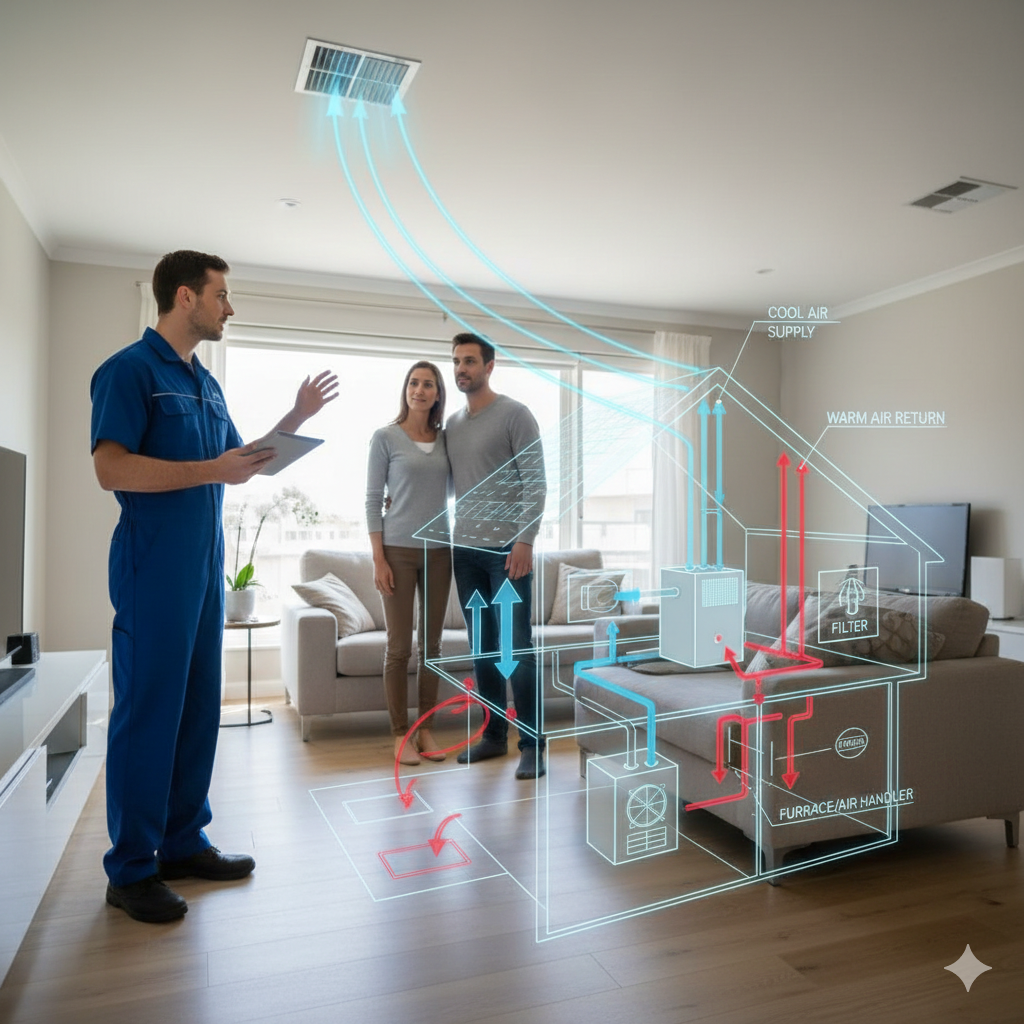
Practical Value: Visualizing the Air Path in Your Home
To tie this process together, follow the path of a single “breath” of air through your home during a cooling cycle:
Delivery: This conditioned air exits through supply vents in each room, lowering the overall temperature and humidity.
Return: Warm air from your living spaces is drawn into the system through return air vents and ducts.
Filtration: This air passes through an air filter, which traps dust and particles.
Heat Exchange: The filtered air is blown by the blower fan over the cold evaporator coil. Here, it loses heat and moisture.
Supply: The now-cooled, dehumidified air is pushed through the supply ductwork.
Common Homeowner Misconceptions About AC Operation
- Myth: Lowering the thermostat to an extreme setting cools the home faster.
- Reality: Air conditioners cool at a fixed rate. Setting the thermostat to 60°F does not make it produce colder air; it simply causes the system to run longer until it reaches that (likely unnecessary) temperature, wasting energy.
- Myth: AC systems need to be recharged with refrigerant regularly.
- Reality: Refrigerant is contained in a sealed loop and should not be consumed or lost. If your system is low on refrigerant, it indicates a leak that must be repaired by a professional. Simply adding refrigerant is not a standard annual service.
- Myth: The outdoor unit just blows hot air; its size and clearance don’t matter much.
- Reality: The condenser unit needs ample clear space (typically at least 2-3 feet on all sides) for proper airflow. Blocking it with plants, debris, or fences restricts its ability to expel heat, forcing it to work harder and reducing efficiency.
Conclusion
Understanding how air conditioning systems work provides valuable insight into one of your home’s most important mechanical systems. The process is not about generating cold, but about the precise and continuous transfer of heat and moisture from inside your home to the outside. This is achieved through the coordinated function of the compressor, coils, fans, and refrigerant in a repeated cycle.
With this knowledge, you can better appreciate the system’s needs, from maintaining clear airflow around the outdoor unit to changing the air filter regularly. This foundational understanding helps you make informed decisions about usage, maintenance, and when to call a qualified HVAC technician for service.